
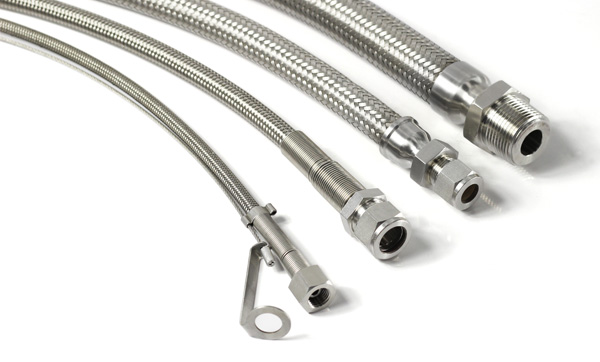
Selang logam Hikelok meliputi selang MF1 dan selang PH1. Karena penampilannya hampir sama, sulit untuk membedakannya hanya dari tampilannya. Oleh karena itu, makalah ini menganalisis perbedaan keduanya dari aspek struktur dan fungsi, agar memudahkan semua orang untuk lebih memahami dan membuat pilihan yang tepat sesuai dengan kondisi kerja aktual saat membeli.
Perbedaan antara selang MF1 dan selang PH1
Struktur
Lapisan luar seri MF1 dan seri PH1 terbuat dari jalinan 304. Jalinan dengan struktur ini meningkatkan nilai daya dukung tekanan selang, yang fleksibel dan mudah ditekuk. Perbedaannya terletak pada material tabung intinya. Tabung inti MF1 adalah tabung bergelombang 316L, sedangkan tabung inti PH1 adalah tabung lurus halus yang terbuat dari politetrafluoroetilena (PTFE). (lihat gambar berikut untuk perbedaan tampilan dan internal yang spesifik)
Gambar 1 Selang MF1
Gambar 2 Selang PH1
Fungsi
Selang logam MF1 memiliki kinerja yang sangat baik dalam ketahanan api, ketahanan suhu tinggi, dan kedap udara yang baik, sehingga sering digunakan dalam kondisi suhu tinggi dan vakum. Karena desain struktural dari material logam sepenuhnya, ketahanan korosi selang sangat meningkat dan tidak tembus udara. Dalam kondisi kerja dengan media transmisi korosif, selang ini juga dapat memastikan pengoperasian yang aman dan stabil.
Karena tabung inti selang PH1 terbuat dari PTFE, yang memiliki stabilitas kimia yang sangat baik, ketahanan terhadap korosi kimia, ketahanan terhadap oksidasi, pelumasan tinggi, tidak kental, ketahanan terhadap cuaca, dan kemampuan anti-penuaan, selang PH1 sering digunakan dalam kondisi kerja pengangkutan media yang sangat korosif. Perlu dicatat di sini bahwa PTFE adalah material yang permeabel, dan gas akan menembus melalui rongga-rongga dalam material tersebut. Permeabilitas spesifik akan dipengaruhi oleh kondisi kerja pada saat itu.
Melalui perbandingan karakteristik kedua selang di atas, saya yakin Anda memiliki pemahaman tertentu tentang kedua selang tersebut, tetapi faktor-faktor berikut perlu dipertimbangkan saat memilih jenisnya:
Tekanan kerja
Pilih selang dengan rentang tekanan yang sesuai berdasarkan kondisi kerja aktual. Tabel 1 mencantumkan tekanan kerja dari dua selang dengan spesifikasi berbeda (diameter nominal). Saat memesan, perlu untuk mengklarifikasi tekanan kerja saat digunakan, dan kemudian memilih selang yang sesuai berdasarkan tekanan kerja tersebut.
Tabel 1 Perbandingan tekanan kerja
Ukuran Selang Nominal
Tekanan Kerja
psi (bar)
Selang MF1
Selang PH1
-4
3100(213)
2800(193)
-6
2000(137)
2700(186)
-8
1800(124)
2200(151)
-12
1500(103)
1800(124)
-16
1200 (82,6)
600 (41,3)
Catatan: tekanan kerja di atas diukur pada suhu lingkungan 20℃(70℉)
Media kerja
Di satu sisi, sifat kimia media juga menentukan pemilihan selang. Memilih selang sesuai dengan media yang digunakan dapat memaksimalkan kinerja selang dan menghindari kebocoran yang disebabkan oleh korosi media terhadap selang.
Tabel 2 Perbandingan material
Jenis Selang
Bahan Tabung Inti
MF1
316L
PH1
PTFE
Seri MF1 adalah selang baja tahan karat, yang memiliki ketahanan korosi tertentu, tetapi jauh lebih rendah daripada selang PH1 dalam hal ketahanan korosi kimia. Karena stabilitas kimia PTFE yang sangat baik di dalam tabung inti, selang PH1 dapat menahan sebagian besar zat kimia, dan dapat bekerja secara stabil bahkan dalam media asam-basa kuat. Oleh karena itu, jika medianya adalah zat asam dan basa, selang PH1 adalah pilihan terbaik.
Suhu kerja
Karena material tabung inti selang MF1 dan selang PH1 berbeda, tekanan kerjanya juga berbeda. Dari tabel 3, mudah dilihat bahwa selang seri MF1 memiliki ketahanan suhu yang lebih baik daripada selang seri PH1. Ketika suhu lebih rendah dari -65°F atau lebih dari 400°F, selang PH1 tidak cocok untuk digunakan. Pada saat ini, selang logam MF1 harus dipilih. Oleh karena itu, saat memesan, suhu kerja juga merupakan salah satu parameter yang harus dikonfirmasi, agar kebocoran selang selama penggunaan dapat dihindari semaksimal mungkin.
Tabel 3 Perbandingan suhu operasi selang
Jenis Selang
Suhu Kerja℉(℃)
MF1
-325℉ hingga 850℉(-200℃ hingga 454℃)
PH1
-65℉ hingga 400℉(-54℃ hingga 204℃)
Permeabilitas
Tabung inti seri MF1 terbuat dari logam, sehingga tidak ada penetrasi, sedangkan tabung inti seri PH1 terbuat dari PTFE, yang merupakan bahan permeabel, dan gas akan menembus melalui celah pada material tersebut. Oleh karena itu, perhatian khusus harus diberikan pada kondisi aplikasi saat memilih selang PH1.
Pelepasan media
Tabung inti selang MF1 memiliki struktur bellow, yang memiliki efek penghambatan tertentu pada media dengan viskositas tinggi dan fluiditas rendah. Tabung inti selang PH1 memiliki struktur tabung lurus yang halus, dan material PTFE itu sendiri memiliki pelumasan yang tinggi, sehingga lebih kondusif untuk aliran media dan memudahkan perawatan serta pembersihan sehari-hari.
Sebagai tambahanSelang MF1DanSelang PH1Hikelok juga memiliki selang PB1 danselang tekanan ultra tinggijenis. Saat membeli selang, seri produk Hikelok lainnya dapat digunakan bersamaan.Fitting tabung ferrule ganda, fitting pipa, katup jarum, katup bola, sistem pengambilan sampel, dll. juga dapat disesuaikan sesuai dengan kondisi kerja khusus.
Untuk detail pemesanan lebih lanjut, silakan lihat pilihan yang tersedia.katalogpadaSitus web resmi HikelokJika Anda memiliki pertanyaan terkait pemilihan produk, silakan hubungi staf penjualan profesional online Hikelok yang beroperasi 24 jam.
Hikelok's metal hoses include MF1 hose and PH1 hose. Because their appearance is roughly the same, it is not easy to distinguish them from their appearance. Therefore, this paper analyzes their differences from the aspects of structure and function, so as to facilitate everyone to have a deeper understanding of them and make a correct choice in combination with their actual working conditions when purchasing.
Differences between MF1 hose and PH1 hose
Structure
The outer layers of MF1 series and PH1 series are made of 304 braid. The braid of this structure increases the bearing pressure value of the hose, which is flexible and easy to bend. The difference lies in the material of their core tube. MF1 core tube is a 316L corrugated tube, while PH1 core tube is a smooth straight tube made of polytetrafluoroethylene (PTFE). (see the following figure for specific appearance and internal differences)
Figure 1 MF1 Hose
Figure 2 PH1 Hose
Function
MF1 metal hose has excellent performance in fire resistance, high temperature resistance and good air tightness, so it is often used in high temperature and vacuum occasions. Due to the structural design of all metal materials of the hose, the corrosion resistance of the hose is greatly improved and has no permeability. Under the working condition of corrosive transmission medium, it can also ensure safe and stable operation.
As the core tube of PH1 hose is made of PTFE, which has excellent chemical stability, chemical corrosion resistance, oxidation resistance, high lubricity, non viscosity, weather resistance and anti-aging ability, PH1 hose is often used under the working condition of conveying highly corrosive media. It should be noted here that PTFE is a permeable material, and the gas will penetrate through the voids in the material. The specific permeability will be affected by the working conditions at that time.
Through the comparison of the characteristics of the above two hoses, I believe you have a certain understanding of the two hoses, but the following factors need to be considered when selecting the type:
Working pressure
Select the hose with appropriate pressure range according to the actual working conditions. Table 1 lists the working pressure of the two hoses with different specifications (nominal diameter). When ordering, it is necessary to clarify the working pressure when using, and then select the appropriate hose according to the working pressure.
Table 1 Comparison of working pressure
Nominal Hose Size
Working Pressure
psi(bar)
MF1 Hose
PH1 Hose
-4
3100(213)
2800(193)
-6
2000(137)
2700(186)
-8
1800(124)
2200(151)
-12
1500(103)
1800(124)
-16
1200(82.6)
600(41.3)
Note: the above working pressure is measured at the ambient temperature of 20 ℃ (70 ℉ )
Working medium
On the one hand, the chemical properties of the medium also determine the selection of the hose. Selecting the hose according to the medium used can give full play to the performance of the hose to the greatest extent and avoid leakage caused by the corrosion of the medium to the hose.
Table 2 Material comparison
Hose Type
Core Tube Material
MF1
316L
PH1
PTFE
MF1 series is stainless steel hose, which has certain corrosion resistance, but it is far inferior to PH1 hose in chemical corrosion resistance. Due to the excellent chemical stability of PTFE in the core tube, PH1 hose can withstand most chemical substances, and can work stably even in strong acid-base medium. Therefore, if the medium is acid and alkaline substances, PH1 hose is the best choice.
Working temperature
Because the core tube materials of MF1 hose and PH1 hose are different, their working pressure is also different. It is not difficult to see from table 3 that MF1 series hose has better temperature resistance than PH1 series hose. When the temperature is lower than - 65 ° f or more than 400 ° F, PH1 hose is not suitable for use. At this time, MF1 metal hose should be selected. Therefore, when ordering, the working temperature is also one of the parameters that must be confirmed, so as to avoid leakage of the hose during use to the greatest extent.
Table 3 Comparison of hose operating temperature
Hose Type
Working Temperature ℉(℃)
MF1
-325℉ to 850℉(-200℃ to 454℃)
PH1
-65℉ to 400℉(-54℃ to 204℃)
Permeability
MF1 series core tube is made of metal, so there is no penetration, while PH1 series core tube is made of PTFE, which is a permeable material, and gas will penetrate through the gap in the material. Therefore, special attention should be paid to the application occasion when selecting PH1 hose.
Discharge of medium
The core tube of MF1 hose is a bellows structure, which has a certain blocking effect on the medium with high viscosity and poor fluidity. The core tube of PH1 hose is a smooth straight tube structure, and PTFE material itself has high lubricity, so it is more conducive to the flow of medium and convenient for daily maintenance and cleaning.
In addition to MF1 hose and PH1 hose, Hikelok also has PB1 hose and ultra-high pressure hose types. When purchasing hoses, Hikelok's other series of products can be used together. Twin ferrule tube fittings, pipe fittings, needle valves, ball valves, sampling systems, etc. can also be customized according to special working conditions.
For more ordering details, please refer to the selection catalogs on Hikelok's official website. If you have any selection questions, please contact Hikelok's 24-hour online professional sales personnel.